What does it take to design a data centre that performs well in measured, day-to-day operation? In this article, we focus on the decisions that have the greatest practical impact on energy efficiency, NABERS ratings, water consumption and on the total cost of ownership over a facility’s life.
The strategies we outline are proven, reflect what our clients are genuinely asking for and deliverable in the Australian market.
We believe the single most important thing you can do for data centre sustainability is get the operational efficiency right. Everything else flows from that.
Operational Efficiency as the Defining Measure of Performance
Data centres are the most operationally intensive building type. Unlike a commercial office that might consume 200 to 400 kWh per square metre annually, a hyperscale data centre can consume upwards of 10,000 kWh. The sheer scale of energy throughput means that even a modest efficiency gain translates into millions of dollars in operational savings and significant reductions in operational carbon emissions.
Performance is largely determined by the decisions made during design in the first months of a project. This includes the choice of cooling architecture, electrical distribution topology, control strategies and metering frameworks. Retrofitting a poorly-designed cooling plant or electrical distribution system after construction can often be prohibitively expensive and disruptive.
A power usage effectiveness (PUE) improvement of just 0.05 saves approximately 26,000 MWh of energy per year. This is equivalent to AU$3 to 4 million in electricity costs and over 13 tonnes of CO₂ annually at current grid intensity (NEM).
Improving operational efficiency
60 MW IT Load, 0.05% PUE improvement

26,000 MWH saved

AU$3M – $4M saved

13,000 tonnes CO2 reduced
This is why we argue that operational efficiency is the most important metric for data centre performance. It determines your energy bill, NABERS rating, carbon footprint and capacity to pursue more advanced sustainability outcomes like waste heat recovery.
Investing more in design and equipment upfront to achieve a lower PUE delivers compounding returns over a 20 to 30-year asset life.
Designing for How Data Centres Actually Run
There’s a gap in the industry between design assumptions and real operating conditions. Historically, data centres have typically been designed for worst-case peak scenarios: full IT load, hottest ambient temperature, maximum cooling demand. Yet, most facilities spend the majority of their operating life at partial load, often 40 to 70% of design capacity, and in ambient conditions well below the design peak.
This matters because equipment efficiency varies significantly with load:
- A chiller optimised for peak capacity may deliver a strong coefficient of performance (COP) at 100% load but perform poorly at 30%.
- A fan system designed for maximum airflow can waste energy when the data hall is only half populated.
- An electrical distribution chain sized for full capacity introduces fixed losses that become proportionally larger as a percentage of actual IT load at lower utilisation.
Part-load performance is the real design challenge
The best-performing data centres are designed around part-load operation. This means selecting equipment with strong turndown characteristics, designing cooling systems that can stage as load varies and building in flexibility to add capacity incrementally.
Over-design is one of the most common efficiency traps. It’s natural to want generous safety margins but the key is to design for scalability, matching installed capacity to actual demand.
A facility designed with build-as-you-go scalability can avoid stranded capacity, reduce day-one capital expenditure and deliver better part-load efficiency throughout its operating life.
NABERS as a Measured Outcome
The NABERS Energy rating for data centres has shifted the conversation in Australia from design intent to measured, in-use performance. A data centre is no longer judged by the efficiency of its installed equipment in isolation but by how effectively the whole system performs when it’s actually running with real operating conditions.
What does a strong NABERS rating actually require?
Achieving a 5 to 5.5 Star NABERS Energy rating, which we consider a realistic target for well-designed new facilities in Australia, depends on several things working together. These include:
- systems performing efficiently at part load
- accurate metering that captures true IT load and total facility energy
- controls that respond dynamically to IT demand, ambient conditions and plant staging
- ongoing tuning and operational discipline that maintains performance after commissioning.
A 5 Star NABERS Energy for Data Centres rating is now mandatory for any operator chasing Federal workloads. While disclosure remains voluntary for the rest of the market, the expansion of the successful Commercial Building Disclosure Program, staged through to 2035, signals that mandatory energy transparency is on its way.
NABERS and PUE
NABERS Energy for Data Centres rates actual operational performance. Higher star ratings reflect lower energy use (lower PUE) and stronger outcomes.
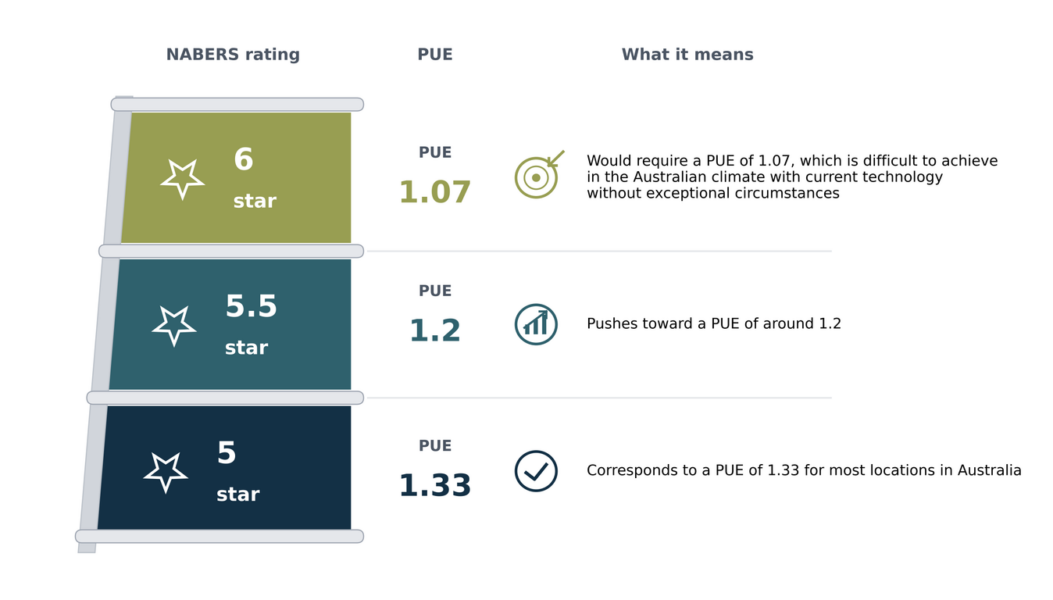
- A 5 Star NABERS Energy rating corresponds to a PUE of 1.33 for most locations in Australia.
- A 5.5 Star rating pushes toward a PUE around 1.2.
- A 6 Star rating would require a PUE of 1.07, which in the Australian climate and with current technology is difficult to achieve without exceptional circumstances. These could be a major adjacent heat user that effectively offsets facility energy through waste heat recovery credits or an immersion cooling strategy.
Targeting 5 to 5.5 requires genuine design commitment and operational commitment. A 6 Star outcome, while not impossible, should be understood as aspirational rather than a standard design target. Any claims of 6 Star potential should be scrutinised carefully for the assumptions behind them.
NABERS performance is designed-in early but proven over time. Without genuine operational efficiency embedded in design, high ratings and broader sustainability outcomes aren’t achievable.
Cooling Efficiency hierarchy
Cooling is the largest parasitic energy consumer in a data centre as well as where the greatest efficiency gains are available.
The inverted pyramid of cooling efficiency
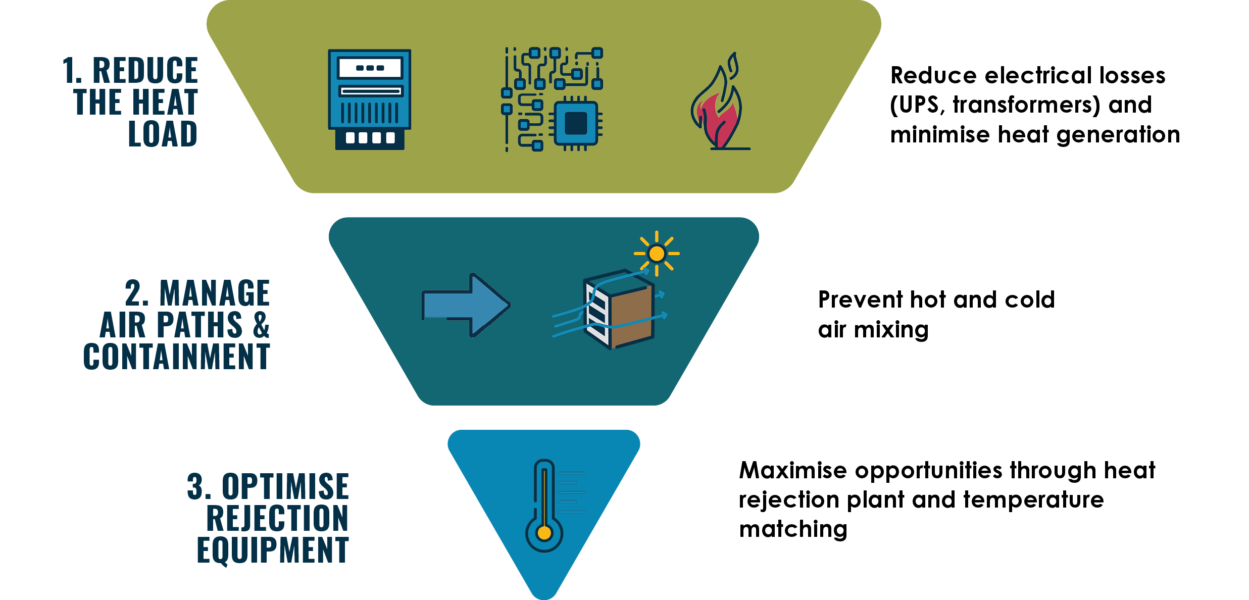
The pyramid of cooling efficiency
1. Start with the heat load
The most effective cooling strategies reduce the amount of heat that needs to be mechanically rejected. Minimise electrical losses through the distribution chain (every watt lost in a transformer or UPS becomes a watt of heat that must be cooled).
2. Manage air paths and containment
The next tier manages how that heat is moved. Prevent mixing of hot and cold air streams; avoid bypass air and short-circuiting; and minimise unnecessary pressure drops and fan energy.
3. Design the rejection system for the actual thermal profile
The final tier relates to the efficiency of the rejection equipment. Match plant selection to the temperatures available, not just the total heat load.
Separating cooling loops unlocks efficiency
AI-ready data centres often need to support both air-side cooling for the data hall and liquid cooling for direct-to-chip or immersion applications. These systems operate at different water temperatures so separating them into high-temperature and medium-temperature loops allows each load to be served by the most efficient cooling plant. This can increase free-cooling opportunities, reduce chiller energy and improve overall energy performance.
| Cooling approach | What it serves | Temperature requirement | Plant strategy |
|---|---|---|---|
| High-temperature loop | Direct-to-chip or immersion cooling loads | Typically, 30–35°C supply to coolant distribution units | Cooling towers, hybrid coolers or high-efficiency air-cooled chillers with free cooling |
| Medium-temperature loop | Air-side cooling for CRAHs, fan walls and the data-hall environment | Cooler chilled water than liquid cooling loads | Chillers with free-cooling capability |
| Separated-loop / 4-pipe strategy | High-temperature and medium-temperature cooling loads | Each loop operates at the temperature range required by its load | Most efficient cooling plant selected for each loop |
Flexibility for a changing industry
The ratio of liquid-cooled to air-cooled racks depends on the tenant, IT hardware generation and workload type. A facility designed today might start with 15% AI racks and grow to 75% over its life. The cooling architecture must accommodate this shift without stranding capacity or requiring major plant.
Centralised, flexible cooling plant with the ability to shift load between cooling loops is essential. As the proportion of liquid-cooled racks increases, the high-temperature loop grows and the chiller plant can be progressively decommissioned or reallocated. This avoids both stranded capital and stranded energy.
Designing for maximum flexibility, to suit both cloud and AI, can reduce energy efficiency as systems must support multiple cooling approaches and operate less optimally. By contrast, setting a clear, forward-looking basis of design, such as a predominantly liquid-cooled solution, allows systems to be simpler, more efficient and better aligned with future demand.
Water use
Evaporative cooling – open cooling towers or hybrid adiabatic coolers – is the most energy-efficient heat rejection available, particularly in warmer months. However, the water it consumes a genuine concern in many Australian locations.
| Heat rejection approach | Water use | Energy use | Design implication |
|---|---|---|---|
| Water-cooled systems | Highest water use | Lowest electricity consumption and lowest PUE | Best energy performance where water availability and site constraints allow |
| Air-cooled / dry systems | No water use | Higher electricity consumption with a significant energy penalty | Removes reliance on water but may compromise energy performance |
| Hybrid coolers | Uses water only when needed | Lower energy use than fully dry systems in warmer conditions | Provides a middle path by running dry in cooler months and using evaporative assistance when ambient conditions require |
The right answer depends on the site, local water availability and owner’s priorities. A well-designed system, with appropriate cooling technology, treatment and operational management, should target an annualised WUE below 0.4 L/kWh for potable water in water-stressed locations.
Higher thresholds should only be tolerated where alternative water sources or local conditions justify. The optimal design will balance PUE and water usage effectiveness (WUE) according to local climate, water availability and operational requirements.
Electrical Efficiency
Every piece of electrical equipment – transformers, switchgear, uninterruptible power supplies (UPS) and power distribution units – has an efficiency rating and introduces losses. The cumulative effect of these losses is substantial. On a 60 MW facility, even a 2% improvement in electrical distribution efficiency saves over 10,000 MWh per year.
While impedance may be introduced in electrical systems for protection and fault-limiting purposes, distribution losses should be avoided. Unlike IT load, which produces useful computation, they are dissipated as heat and must be removed by the cooling system, compounding the overall energy penalty.
Changing voltage and distribution values
A significant opportunity in electrical efficiency is moving to either medium voltage (MV) distribution, by using MV UPS systems, or adapting to an 800V DC bus system that directly supplies IT racks.
MV UPS systems use lithium-ion batteries which operate at higher efficiencies to their LV counterparts and offer additional advantages:
- They’re more compact
- They have a smaller footprint
- They can provide grid support functions, i.e. load stabilisation during AI training cycles where GPU workloads create rapid load transients that can stress conventional power systems.
Distributing direct at a DC voltage to the IT racks avoids the need to transform the voltage waveform multiple times, reducing losses and equipment.
Right-sizing and staging
Electrical equipment also performs best when loaded appropriately. Oversized UPS systems operating at low utilisation have proportionally higher losses. Designing the electrical system for incremental deployment, adding UPS modules and transformer capacity as load grows, keeps equipment operating closer to its optimal efficiency point.
Distributed-redundant architectures, where multiple power blocks share the load, improve utilisation ratios compared to traditional 2N designs. Each power block runs at a higher percentage of its rated capacity, reducing the proportional impact of fixed losses while still providing the required redundancy for Tier III concurrent maintainability.
Waste Heat Recovery
Data centres convert almost all of their electrical input into heat. Capturing and reusing that heat can improve overall resource efficiency. However, there needs to be a suitable nearby demand, the right temperature profile and a practical way to transfer it. Without those conditions, waste heat recovery adds complexity without meaningful benefit.
The temperature challenge
Today, most data centre waste heat is relatively low grade. Air-cooled systems reject heat at 35 to 45°C. Even D2C cooling loops typically return water at 45 to 65°C. For most heating applications – such as space heating, domestic hot water, industrial process heat – these temperatures need to be boosted by heat pumps, which adds cost, complexity and energy consumption. This can erode the net benefit.
However, this is changing and within the next few years, waste heat may be available at temperatures that are useful without the need for heat-pump boosting. This is because rack power densities and liquid cooling are on the rise which means return water temperatures are too. Next-generation GPU platforms already produce return temperatures approaching 65°C.
Waste heat feasibility
For waste heat recovery to be viable, 3 conditions must be met:
- A viable heat user – within practical piping distance with a load profile that aligns reasonably with the data centre’s heat output
- Suitable temperature levels – either heat at a grade that’s directly usable or a heat pump arrangement where the economics stack up
- Operational certainty – the data centre must be running reliably and predictably and the heat offtake arrangement must not compromise the cooling system’s performance or availability
- Utility support – in Australia and New Zealand, if a district heating system is to be proposed then it’s considered a utility resource so legislation needs to be in place for the facility to operate as a utility.
The Australian climate
Australia’s climate makes district heating less universally applicable than in Northern Europe or North America. In many locations, there’s limited year-round demand for space heating. However, opportunities do exist: industrial preheating for food processing or manufacturing, heated water for aquaculture, agricultural applications such as greenhouse heating and swimming pool heating are all potential use cases that can absorb heat year-round.
Our recommendation is to design data centres to be heat-recovery ready, ensuring that the cooling architecture, pipework routing and spatial allowances don’t preclude future heat offtake. This preserves the option at minimal upfront cost while the market for waste heat matures.
Controls & operations
Even the best-designed cooling and electrical systems underperform if they aren’t operated well. Advanced controls allow systems to adjust in real time to changes in load and weather conditions.
We’ve seen clients start to trial this within existing facilities to help optimise performance throughout the year, improving efficiency and reducing energy use compared to fixed control settings.
Controls that support real behaviour
Control strategies must be designed for the way operators actually work. This means providing clear, actionable information about system performance; automating routine optimisation decisions (such as chiller staging and setpoint adjustment); and building in safeguards that prevent well-intentioned manual overrides from degrading efficiency.
Too often, sophisticated control sequences are commissioned once and then progressively overridden as operators encounter unfamiliar conditions or respond to alarm fatigue. This leads to a facility drifting away from its design intent.
Tuning isn’t commissioning
Commissioning verifies that systems work as designed under controlled conditions. Tuning is the ongoing process of optimising performance under real, varying conditions over months and years. A data centre that’s commissioned but never tuned won’t achieve its potential NABERS rating.
This requires metering infrastructure, regular performance analysis and a culture of continuous improvement. The metering framework must be designed from the outset to support NABERS reporting requirements with accurate sub-metering of IT load, mechanical plant, electrical losses and ancillary loads. Gaps or inaccuracies in metering directly undermine the ability to identify and correct inefficiencies.
Systems only perform as well as they’re operated. The design must support the operator, not work against them.
Efficiency First
Operational efficiency is the foundation on which every other sustainability outcome depends.
A data centre with excellent operational efficiency will achieve a high NABERS rating as a matter of course. It will have lower energy costs and carbon emissions and a more viable pathway to waste heat recovery. It will also be more attractive to tenants, many of whom now have their own sustainability commitments and procurement criteria.
Capital investment
Achieving genuine operational efficiency requires capital investment. Higher-efficiency cooling plant, MV electrical distribution, robust metering and controls infrastructure, and flexible mechanical systems all initially cost more than their conventional alternatives.
The returns are compelling:
- On a 60 MW facility with a 25-year operating life, the difference between a PUE of 1.4 and a PUE of 1.2 represents roughly $250 to 350 million in cumulative electricity cost savings.
- The upfront premium to achieve the lower PUE is typically a fraction of this. Even under conservative assumptions, the payback period for efficiency investment is measured in years, not decades.
Indicative impact of PUE on operating cost
| PUE | Total facility load (MW) | Overhead (MW) | Annual overhead energy (MWh) | Annual cost @ $100/MWh | Indicative NABERS outcome |
|---|---|---|---|---|---|
| 1.40 | 84 | 24 | 210,000 | $21.0 million | ~4.5 Star |
| 1.30 | 78 | 18 | 158,000 | $15.8 million | ~5.0 Star |
| 1.20 | 72 | 12 | 105,000 | $10.5 million | ~5.5 Star |
Table load. Energy costs and NABERS correlations are indicative only. Actual NABERS ratings depend on measured performance and climate zone.
Designing for the full operational life
Data centres can have a lifetime of up to 30 years so the mechanical and electrical infrastructure installed today will be operating long after the first generation of IT equipment has been replaced many times over. It’s essential to design cooling plant for over 30 years’ durability, choosing electrical systems that can adapt to changing load profiles and build in the spatial and services flexibility to accommodate future technology shifts.
The performance of the underlying network is also critical. Latency and topology directly influence GPU utilisation, meaning inefficient networks can leave high-value compute idle while still consuming energy. In this context, traditional metrics like PUE only tell part of the story. True operational efficiency is measured by how effectively power, cooling and network infrastructure work together to maximise usable compute and return on investment.
The facilities that perform best over their lifetime are those where the sustainability specialist and mechanical and electrical engineers have worked together from the earliest design stages with a shared understanding of how the building will actually operate.
Balancing efficiency and resilience in the shell and core
Structures and foundations are typically the largest contributors to a building’s embodied carbon. In data centres, however, this is outweighed over time by operational energy use. That doesn’t make structural efficiency any less important, it means it needs to be considered alongside resilience and adaptability. Reducing unnecessary material and unnecessary safety factors is valuable but not at the expense of a structure that can’t evolve with the facility over its life.
Designing for longevity
Make deliberate choices early, for example floor loading.
Data centre white space carries significantly higher loads than commercial buildings, driven by IT racks that continue to become heavier and more dense, particularly with the shift to liquid-cooled systems.
Retrofit projects have shown just how quickly requirements can outgrow original assumptions with older facilities needing upgrades from typical office loads of around 300 kg/m² to localised loads closer to 2,000 kg/m². Plant outside the white space, for example generators, chillers, tanks and UPS systems, adds further demand.
Getting the loading brief right requires close coordination with MEP (mechanical, electrical and hydraulics) engineers and a clear allowance for future increases.
The structural grid
The spans reduce column interference and improve flexibility for rack layouts. But, they come with increased structural depth and cost. Tighter grids are more efficient structurally but can limit usable space and IT capacity.
Finding the right balance depends on early collaboration between structural, MEP and planning teams, weighing capital cost against long-term operational performance.
Future readiness
This is where good structures prove their value. Allowing space for change, through larger risers, planned service penetrations, adaptable zones within slabs, roof capacity for additional plant and spare capacity in foundations can significantly extend the life of the building.
Foundations, in particular, are difficult to modify later so getting this right upfront avoids costly and carbon-intensive interventions down the line.
Ultimately, structural design in data centres is about enabling performance over decades, supporting evolving technology, maintaining operational efficiency and avoiding premature rebuild. This balance is best achieved through an integrated design approach from the outset.
The future of data centres starts now
The data centre industry in Australia is at an inflection point. The facilities being designed now will define the sector’s energy and water footprint for decades. Getting the fundamentals right – cooling architecture, electrical distribution, controls and operational frameworks – is the work that matters most.
Operational efficiency is good engineering and economics and the responsible thing to do with assets of this scale and impact. These strategies require expertise and early commitment and they deliver outcomes that compound over the life of the facility.