New buildings are often seen as the obvious route to better efficiency, comfort, amenities and overall higher performance. However, as global carbon targets tighten the industry is rethinking this assumption. Retrofit is no longer a fallback. In many cases, it’s the commercially smarter, lower carbon and equally high performing choice.
For owners of existing buildings, the challenge is both technical and strategic. In a rapidly evolving regulatory and market landscape, the question is no longer ‘Should we retrofit?’. It’s now ‘How can we make retrofitting outperform new build in the race to net zero?’
The carbon equation: RETROFIT’S GREATEST EDGE
Every building carries 2 carbon burdens which make up the life cycle emissions of a building:
- Embodied carbon – emissions associated with materials, construction and maintenance
- Operational carbon – emissions from energy use during the lifetime of a building.
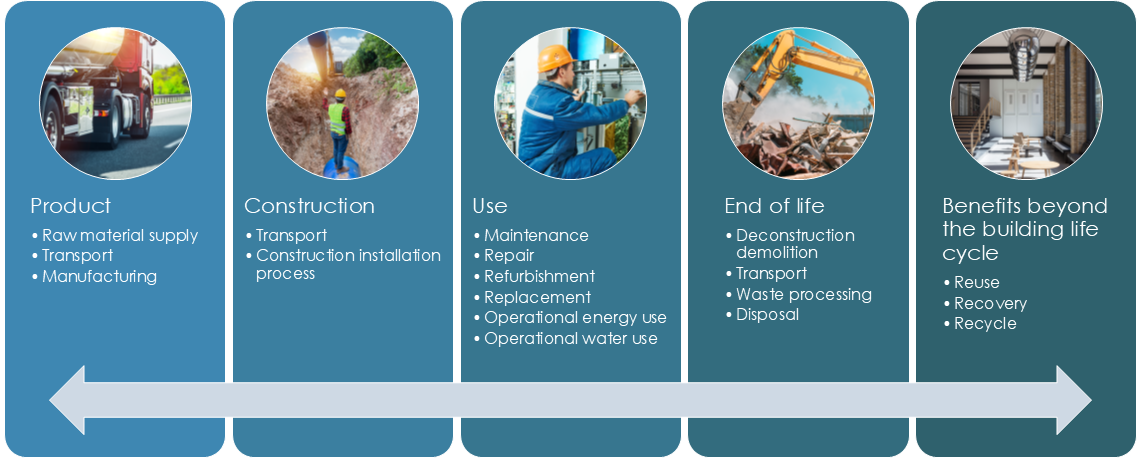
Retrofitting, in most cases, aims to preserve the substructure and structure – the most intensive part of any building’s embodied carbon. This gives retrofits an immediate advantage over a new build.
Despite these benefits, embodied carbon is still largely overlooked in both policy and practice. The lack of clear and consistent regulation means that its significance, and the major advantage it offers for retrofitting existing building stock, remains underappreciated.
Forty-one countries have implemented mandatory building codes to regulate operational energy. Only a handful of countries, such as the UK, Canada, France, USA, Netherlands and some states in Australia, have developed policies specifically targeting embodied carbon, despite its critical role in achieving carbon neutrality. Embodied carbon can account for over half of a building’s total emissions over its lifetime, especially as grids decarbonise and operational energy use drops in efficient building services design.
The adoption of embodied carbon policy is shaped by a range of factors, including global trade dynamics, supply chains, economic conditions and the environmental risks faced by different countries.
Supporting the circular economy
While new builds can be designed for future circularity, retrofitting delivers immediate and tangible circular economy benefits by prioritising retention, reuse and resource efficiency.
- Maximising material retention – retrofit can preserve the existing structure, foundations and significant portions of the building envelope and internal finishes. This reduces demand for new resources.
- Reducing demolition waste – as the building isn’t being knocked down, there’s significantly less waste that needs to be taken to landfill or processed in a recycling stream.
- Enabling adaptive reuse – retrofit allows buildings to be repurposed for new uses without the need for new construction. This adaptability keeps assets relevant, productive and extends their lifespan.
- Preserving social and cultural value – beyond physical materials, retrofit retains the cultural, historical and social value embedded in existing buildings, an often-overlooked aspect of circularity.
- Minimising energy and water use in construction – retrofit typically requires less energy and water during construction compared to a new build as fewer heavy processes are needed, for example concrete curing or steel fabrication.
Design constraints that become catalysts for innovation
Retrofit projects often begin with constraints such as heritage, structural and spatial limitations. We’ve found these challenges can spark more integrated, and holistic design approaches.
One example of this is services routing through existing structural components by introducing openings in the steel beams or reinforced concrete. This technique enables the integration of HVAC ductwork, piping or electrical conduits into the refurbished design of the existing building while maximising available headroom and maintaining overall floor-to-ceiling heights. By carefully coordinating these interventions, it’s possible to accommodate new service layouts and enhance building flexibility without compromising spatial quality or structural integrity.
Another example where we acted as sustainability consultant involved using the building’s original 5-metre-high ceilings on the first 3 floors to add an additional storey. This was accomplished by raising the first and second floor slabs by 1.5 metres each, effectively transforming them into new second and third floors. Through this approach, 80% of the original steel frame and 70% of the concrete were retained during the renovation.
Working with existing buildings is inherently complex, requiring a careful balance between irreversible capital decisions, long-term carbon reduction goals and evolving regulatory requirements. Yet, as these examples demonstrate, such complexity can also unlock opportunities for innovative, sustainable outcomes.
Enabling quicker action on net zero
Achieving net zero by 2050 requires immediate, large-scale action. The window for meaningful intervention is rapidly closing and the built environment is a major contributor to greenhouse gas emissions (25% in the UK).
Early movers who retrofit now will be better positioned to attract tenants, access green finance and command higher asset values as the market shifts toward net-zero alignment.
Retrofit projects can often be delivered faster than new builds due to:
- shorter planning and permitting times (especially where planning policy favours retention)
- less site preparation and groundwork
- the ability to phase works and maintain partial occupancy, reducing disruption and lost revenue.
At their core, buildings are meant to be used, whether as homes, offices or retail spaces. When retrofits are planned to minimise disruption and allow occupants to stay during works, the building continues to deliver value without extended periods of vacancy. This leads to greater business resilience and enhances both the economic and social value of the asset over demolition and new build.
Reaching targets
Because retrofits can be implemented more quickly, it enables earlier carbon savings – crucial for meeting interim targets like 2030 milestones – and cumulative carbon reduction.
Research indicates that portfolios can achieve upward of 20% energy reductions through operational optimisation, alone, before any major CAPEX investment. (NABERS 2022 data).
Regulatory risk
The combination of regulatory pressure and the need for speed means that retrofitting is not just a green choice but a strategic imperative. Owners can avoid being caught out by future policy changes and market shifts.
The limits of retrofit – when new build is still the right path
Although retrofit presents clear advantages, new build remains preferable when:
- the existing structural frame is unsafe or cannot support future loads
- the building is so inefficient that upgrades cannot meet compliance targets
- major functional changes require significant reconfiguration
- extensive accessibility or seismic performance upgrades become economically unviable
- there are site access constraints.
The key is not to force retrofit at all costs but to make evidence-based decisions that balance risk, flexibility and long-term value.
Where to start with retrofit
- Conduct feasibility studies and audits to understand building condition, heritage value and structural integrity. This identifies opportunities and constraints.
- Measure and benchmark performance – use current energy and carbon emission data to pinpoint areas for improvement and compare against industry standards.
- Conduct whole-of-life carbon and cost analysis – evaluate retrofitting versus new-build options using whole-of-life carbon and cost studies.
- Undertake a pre-refurbishment audit and engage with circular economy principles – move from a linear “take-make-dispose” model to a circular one where existing buildings are seen as material banks.
- Model operational energy – use dynamic energy modelling to test and optimise retrofit strategies for real-world performance.
- Engage stakeholders early – involve owners, occupiers, planners and heritage bodies from the outset to align objectives and streamline approvals.
- Plan for future readiness – design with flexibility for future technologies, regulatory changes and evolving user needs. This includes evaluating the asset’s exposure to climate-related risks (such as overheating, flooding and extreme weather) and integrating resilience measures.
- Commit to performance verification – adopt frameworks like NABERS Design for Performance scheme to ensure outcomes match predictions.
The unique opportunity of retrofitting for net zero
Navigating strategic uncertainty
For many asset owners, there’s genuine concern – ‘If I invest heavily now, I might lock the building into the wrong solution. If I don’t, I risk creating an obsolete asset.’
Carbon targets extend decades beyond current leases. Legislation, frameworks, market expectations and technologies are evolving faster than most asset life cycles. Owners are forced to make decisions based on today’s realities, knowing that tomorrow’s requirements may be different.
Building capability, not just upgrading assets
At NDY, we approach retrofitting as an ongoing capability-building exercise. This means stress-testing options against a range of future scenarios:
- What if energy prices double?
- What if temperatures rise?
- What if gas is banned?
- What if carbon reporting tightens or carbon taxes are introduced?
We design for optionality and staging flexibility, prioritising interventions that keep choices open as mandates, technology and tenant needs evolve. Upgrades are often staged to align with tenancy movements and asset conditions. Major decisions are deferred where appropriate.
Immediate upgrades can reduce risk and emissions today while infrastructure is sized for future electrification and load growth. Major investments are timed for when regulatory and market clarity improves.
Ultimately, net zero success in existing buildings is about being adaptable. The most successful owners will be those who are able to respond proactively to change, approaching retrofitting as an ongoing journey.
Why retrofit can outperform new build
While every project should be evaluated on its own merits using robust, evidence-based assessment, retrofitting existing buildings increasingly stands out as a high-performing, flexible and lower-carbon option, often outperforming new build on whole-of-life carbon, cost, speed and resilience.
Regulatory and market pressures are mounting and the window for meaningful climate action is rapidly closing. Those who act decisively now, with an eye toward flexibility and optionality, will be best placed to meet evolving standards, protect asset value and lead the transition to a net zero built environment.
What does stranded look like?
CRREM tool
- The Carbon Risk Real Estate Monitor (CRREM) tool is already being used by investors and asset managers to assess the stranding risk of real-estate portfolios.
- Buildings that don’t align with decarbonisation pathways face declining value and increased regulatory scrutiny.
- Investors are, increasingly, using tools like CRREM and demanding evidence of alignment with net-zero pathways.
- Retrofit demonstrates a proactive approach to risk management and demonstrating environmental, social and governance (ESG) performance, making assets more attractive to forward-looking capital.
Don’t let your asset become stranded
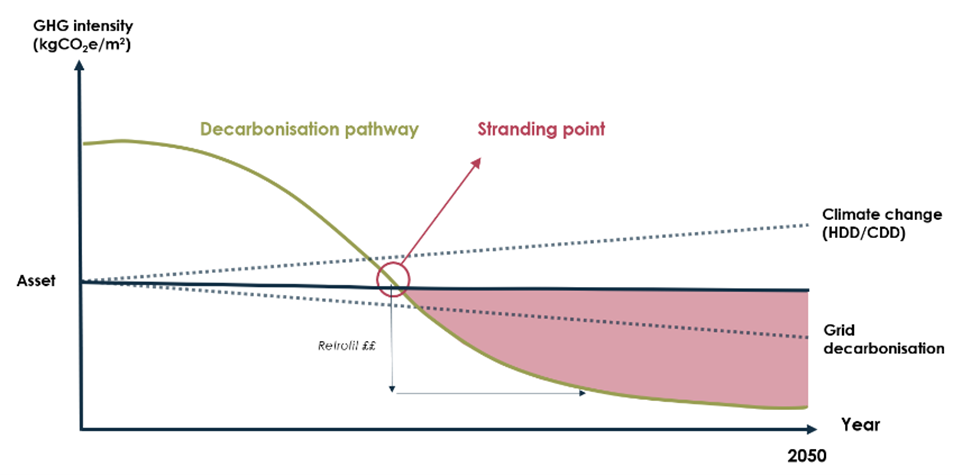
The graph below provides a summary of the fundamental principle of CRREM’s stranding risk analysis approach for single properties.
The black line represents a building’s baseline and future carbon performance in terms of greenhouse gas (GHG) intensity. This is calculated as the amount of annual GHG emissions per building floor area.
Emission figures include those directly generated by the on-site combustion of fossil fuels for heating and indirect emissions, caused by the use of district heating and/or electricity consumption.
The green curve represents the target decarbonisation pathway of a specific building type in a specific country that aligns with a certain climate target (1.5°C/2°C) and must not be exceeded if a property intends to be Paris Agreement-proof.
If the emission intensity is above the target value, stranding occurs. In that case the asset would have a carbon-footprint that is above its fair-share (derived by downscaling the carbon budget to property level).