Some asset owners worry that the ambitious sustainability ratings they’re targeting today (like Green Star, LEED and The WELL Building Standard [WELL]) will be an average outcome by the time they achieve them or outdated before the first light bulb is replaced. This is a reasonable concern; it can take up to 10 years to achieve some goals.
There’s commercial risk associated with unfulfilled tenant and investor expectations as industry standards change and long-term asset performance weakens. If future evolution hasn’t been considered, the cost of retrofitting is considerable, for example changing use types, integrating load growth, electrification or, even, regulatory changes.
Planning for the future aligns better with long-term strategy and performance goals which is more likely to satisfy tenants, investors and leaders.
Is your building future-ready or just certified?
Reframing certification
Rating frameworks evolve at a rapid pace. Green Star, for example, advances its certification requirements through a major overhaul on a 5 – 8 year scale with minor updates on a more regular basis. WELL can be described as a rating journey as projects are required to maintain annual requirements and recertify on a 1 or 3-yearly cycle, rating dependent, with quarterly addenda released to ensure the tool remains up to date. It’s important to approach sustainability accreditation as setting the foundations for operational performance rather than an end goal.
Framework flex
We also need to stay open to that framework flexing as technology, innovation, regulations and expectations change. If we look at the evolution of carbon regulations and mandatory climate disclosures, for example, we can see significant tightening of carbon allowances over the years.
Whole-of-life mindset
It’s critical we approach our sustainability thinking with a whole-of-life carbon approach, capturing both operational and embodied carbon. We must also incorporate the social and cultural impact of our decisions and consider governance principles and practices, ensuring the spaces and environments we create are serving the people and their needs both now and in years to come.
Capabilities that a sustainability framework helps you build
Sustainability rating tools provide a framework that helps you put in place processes and reporting platforms to keep track of your performance over key criteria. The areas covered include what’s considered best practice in the industry, today, such as:
- occupant comfort and wellbeing
- operational efficiency and resilience
- data visibility and digital maturity
- carbon literacy across facilities and operations teams
- continuous commissioning and tuning capability
- portfolio-level performance benchmarking
- supply chain engagement and procurement standards
- transparent ESG reporting
- risk management processes aligned with climate scenarios
- integration between sustainability, asset management and capital planning.
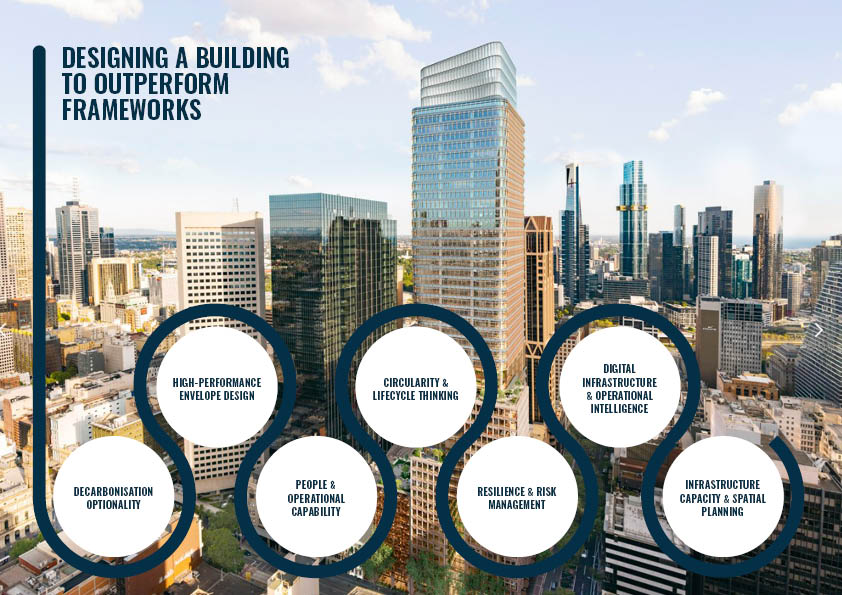
Infrastructure capacity and spatial planning
We need to start with infrastructure that can evolve. A consolidated and accessible services strategy allows systems to be modified or replaced without major spatial rework, tenant disruption or extended downtime. That requires early coordination of plant locations, risers and distribution pathways so additional services can be introduced as needs change.
Flexibility should be embedded in both layout and massing, enabling reconfiguration without structural intervention. Electrical infrastructure needs to be sized with sufficient headroom for increasing digital loads while spatial allowances for future plant upgrades prevent costly retrofits later.
Avoiding single-technology lock-in preserves choice as better-performing systems emerge. And planning for mid-life upgrades from the outset protects long-term asset value.
High-performance envelope design
The building envelope sets the baseline for long-term performance. Passive thermal resilience reduces reliance on mechanical systems and improves stability as climate extremes intensify. Orientation and external shading should be resolved early to limit peak loads and operational volatility rather than compensating through plant capacity.
Integrating solar photovoltaics (PV) across roof and facade surfaces builds in future generation capacity. Envelope performance should also anticipate future system upgrades, ensuring that design doesn’t constrain improvements in mechanical or electrical efficiency.
Digital infrastructure and operational intelligence
Operational performance depends on the quality of data and ability to act on it. Advanced metering infrastructure provides the granularity required to understand actual building behaviour. Controls designed for continuous tuning allow systems to adapt to occupancy, climate and usage changes rather than remaining fixed at practical completion.
By allowing for digital twin capability, or future-ready integration pathways, we can enable optimisation throughout the asset lifecycle. Predictive maintenance, supported by structured reporting, also helps reduce downtime and extend equipment life.
Integration between base building and tenant systems supports consistent ESG reporting.
Decarbonisation optionality
Decarbonisation pathways are unlikely to be delivered in a single intervention. Electrification readiness should be embedded in core infrastructure, allowing a staged transition as grid capacity, policy and technology mature. Designing for grid interaction and demand response capability enables participation in emerging energy markets and reduces peak demand exposure.
By planning for on-site renewables from the outset, we can protect future installation pathways. We should choose materials that focus on durability and reduce embodied carbon.
Circularity and lifecycle thinking
Long-term performance is shaped by how easily a building can be adapted. When we design for disassembly, we allow components to be replaced or upgraded without extensive demolition. Planning for flexibility and adaptive reuse from the beginning acknowledges that our occupancy patterns and functions will change.
Material selection should prioritise durability and longevity, avoiding unnecessary complexity that increases waste during refurbishment. Standardisation, or modularisation, simplifies maintenance and reduces material loss during future upgrades.
Resilience and risk management
Climate and compliance risks need to be addressed as design inputs rather than retrospective checks. Designing for extreme weather events, including heat, storm and flood, protects both operational continuity and occupant safety. Climate scenario modelling allows performance to be tested against future conditions.
It’s also wise to plan for operational continuity so critical systems maintain function during any disruption.
People and operational capability
Building performance ultimately depends on the people operating it. Systems should be designed for facility management teams, with clear access, logical controls and transparent reporting. Embedding carbon literacy across operational teams also helps.
Commissioning and planned re-commissioning strategies help maintain alignment between design intent and operational reality. Clear collaboration pathways between base building and tenants improve shared outcomes, and defined exit strategies at handover support future transactions or repositioning.
Governance structures also enable consistent long-term ESG reporting.
Why accreditation should still be a critical part of your business strategy
Without the guidance, goals and verification that accreditation offers, your ESG impact will be significantly slower. Obtaining third party accreditations can:
- establish strong governance and accountability tools, benchmarks and reporting
- attract high value tenants that are easy to retain
- set a standard for across your portfolio
- accelerate organisational capability
- demonstrate ‘walking-the-talk’ to employees
- build brand reputation with investors and in the market.
Choose the right partner on your accreditation journey
If you’re looking to build robust foundations that you can adapt in line with industry expectations, you’ll need to find a sustainability advisor who doesn’t just administer a rating tool. They must understand how to manage risk, both immediate compliance risk and the longer-term risks associated with regulatory change, market expectations and asset obsolescence.
This requires a working knowledge of the full building system, including architectural design, facade performance, mechanical and electrical services, digital systems and structural constraints. Advice that sits in isolation from these disciplines rarely translates into durable outcomes. Effective partners design for long-term efficiency and remain engaged beyond handover, supporting ongoing performance rather than treating certification as a point-in-time exercise.
They should anticipate regulatory trajectory and embed flexibility early, reducing the likelihood of reactive upgrades as standards evolve. A clear focus on low embodied carbon and circular economy principles is also essential, ensuring material decisions contribute to longevity rather than future liability.
Your advisor should also recognise the impact buildings have on human health and wellbeing, and understand their role in reflecting place and culture. Certification strategy should align with asset repositioning plans and broader lifecycle objectives.
Ultimately, the right partner thinks about the performance and value of your asset well beyond the immediate ratings being targeted. Instead, they position it to remain relevant as frameworks, disclosure requirements and tenant expectations change.